Same Drug, Different Tablet: Decoding Amoxicillin-Clavulanate at the Pharmacy Counter

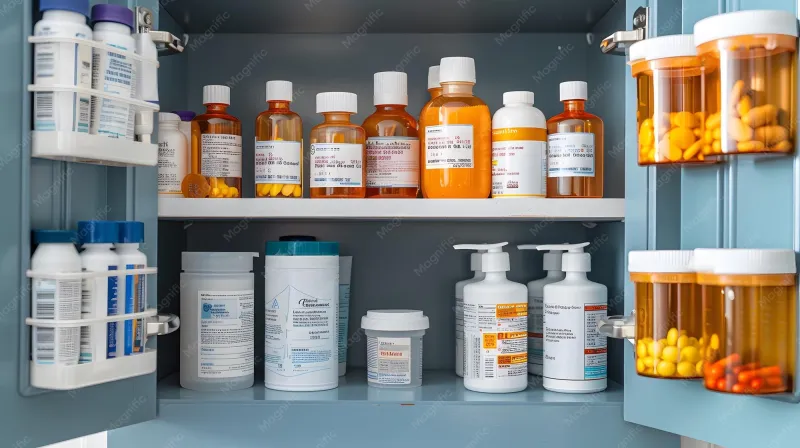
Photo: Rhoda Baer (Photographer), Public domain, via Wikimedia Commons
Why Your Refill Doesn't Look Like the Last One
You pick up a refill of what you believe is the same prescription, and the tablet is a different shape, a different color, and bears a different imprint. The label may read amoxicillin and clavulanate potassium rather than the brand name you remember. Nothing about this is necessarily wrong — but nothing about it is automatically fine, either.
Amoxicillin-clavulanate is a combination drug, and combination drugs have more variables than single-ingredient ones. Two products can share a generic name and still differ in strength, ratio, release mechanism, and formulation. Knowing which differences are cosmetic and which are clinically meaningful is a form of self-advocacy that costs nothing but a few questions.
The Ratio Is the Recipe
Amoxicillin is the antibiotic. Clavulanate is not — it is a beta-lactamase inhibitor, added to block the enzymes some bacteria use to destroy amoxicillin. The two are paired in fixed ratios, and the ratio is part of the prescription.
In the United States you will encounter:
- 250 mg / 125 mg tablets — a 2:1 ratio
- 500 mg / 125 mg tablets — a 4:1 ratio
- 875 mg / 125 mg tablets — a 7:1 ratio
- Extended-release 1000 mg / 62.5 mg tablets — a 16:1 ratio, dosed differently
Pediatric suspensions follow the same logic in liquid form: 125 mg/31.25 mg and 250 mg/62.5 mg per 5 mL, the higher-strength 400 mg/57.5 mg per 5 mL, and the 600 mg/42.9 mg per 5 mL ES-600 formulation.
The important point is that the clavulanate dose is capped in practice. It is the component most associated with diarrhea and other gastrointestinal effects, so higher strengths of amoxicillin are usually paired with the same 125 mg of clavulanate rather than a proportionally larger amount.
Tablet Strengths Are Not Interchangeable Math
Here is where well-intentioned improvisation goes wrong.
A prescription for 875 mg twice daily is not the same as two 500/125 mg tablets twice daily. The amoxicillin comes out close — 1000 mg versus 875 mg — but the clavulanate doubles from 125 mg to 250 mg per dose. That is a meaningful increase in the component most likely to cause stomach upset, and it is not what the prescriber ordered.
Similarly, a 500/125 mg tablet is not half of an 875/125 mg tablet. Splitting the larger tablet yields 437.5 mg of amoxicillin and 62.5 mg of clavulanate — a dose that exists on no prescribing schedule. Scored tablets are designed to be split for dosing convenience only when the split produces a prescribed strength.
If the pharmacy does not have your exact strength, the correct move is a call to the prescriber, not arithmetic at the kitchen table.
Extended-Release Is Its Own Animal
Augmentin XR is a distinct product, not a stronger version of the immediate-release tablet. Its clavulanate content is lower and its amoxicillin is released over time, which is why it is dosed twice daily with food and is approved for specific indications such as community-acquired pneumonia and acute bacterial sinusitis in adults.
Extended-release tablets should not be crushed, chewed, or split. Doing so releases the full dose at once, altering both absorption and the side-effect profile. Extended-release and immediate-release products are not freely substitutable for one another even when the amoxicillin totals look comparable.
The Milligram-per-Milliliter Trap With Liquids
Suspensions are reconstituted at the pharmacy, and different concentrations exist. A caregiver who moves from a 250 mg/5 mL product to a 400 mg/5 mL product and keeps the same volume will give a substantially larger dose. Always confirm the concentration printed on the label, and always use the dosing device that matches it.
Also ask whether the flavoring added by the pharmacy has changed. A child who accepted a bubblegum-flavored suspension may reject a grape one, and a rejected dose is a missed dose.
Splitting, Crushing, and Stretching: Three Ways a Prescription Goes Wrong
Patients stretch prescriptions for understandable reasons — cost, a shortage, a fear of running out before a refill. But:
- Do not split tablets unless the tablet is scored and the split matches a prescribed strength.
- Do not crush extended-release tablets. Immediate-release tablets may sometimes be crushed or mixed with food if your pharmacist confirms it for your product, but this is product-specific.
- Do not stretch a course by taking half doses to make the supply last. Sub-therapeutic dosing is exactly the condition under which resistance develops.
- Do not substitute one formulation for another to bridge a gap without professional input.
Questions to Ask Before You Leave the Counter
Ask these out loud. A good pharmacist will welcome them.
- Is this the same strength and ratio my prescriber wrote, or a substitution?
- If it is a substitution, did you contact the prescriber, and did they approve it?
- Is this immediate-release or extended-release?
- Can this specific tablet be split or crushed?
- What is the concentration on this liquid, and which measuring device should I use?
- Does this product need refrigeration, and what is the discard date?
- Is the manufacturer different from last time, and does that change anything about how I take it?
If the Answer Doesn't Satisfy You
You are entitled to ask the pharmacist to call the prescriber, to wait for the exact product, or to transfer the prescription to another pharmacy. Insurance formularies and supply problems sometimes make substitution tempting, but substitutions that change the clavulanate dose or the release mechanism are not small matters.
Generic amoxicillin-clavulanate is a legitimate, well-regulated product, and most differences between fills are purely cosmetic. The skill worth developing is knowing which question to ask — and asking it before you swallow the first dose, not after.